← Back to Library

What Is Bazi? Four Pillars

BAZI 八字 · FOUR PILLARS · TEN GODS · LI CHUN DATES

KEY TAKEAWAYS / TL;DR

  • Bazi, also called the Four Pillars of Destiny or Eight Characters, is a Chinese birth-chart system built from the Stem-Branch pairs of the birth year, month, day, and hour.
  • A chart uses 10 Heavenly Stems, 12 Earthly Branches, hidden stems, Five Element relationships, and the Day Master to describe symbolic temperament and timing patterns.
  • Bazi dates are not simply lunar-calendar dates: many charts use Li Chun for the Year Pillar and solar terms for Month Pillars, so early-February births need a stated calendar rule.

By the Numbers

4
Pillars
Year, month, day, and hour define the chart.
8
Characters
Each pillar has one Stem and one Branch.
60
Jiazi Cycle
Every pillar is drawn from the sexagenary cycle.
Calculate Your Bazi ChartEnter your birth details to explore your symbolic chart structure →

Direct answer: Bazi is a Chinese birth-chart framework, also known as the Four Pillars of Destiny or Eight Characters. It maps the birth year, month, day, and hour into four Stem-Branch pairs from the Sexagenary Cycle. The result is a symbolic timing map used in traditional Chinese metaphysics, not a scientific prediction or fixed life verdict.

The conceptual foundation of Bazi traces back to the Han Dynasty (206 BCE – 220 CE), emerging from correlative cosmology that linked celestial phenomena with terrestrial human affairs. The fundamental mechanism of stem-branch chronometry (pairing stems and branches) can be historically verified through oracle bone inscriptions from the Shang Dynasty (c. 1600–1046 BCE).

The formal systematization of astrology using three pillars (year, month, day) was pioneered by the Tang Dynasty scholar Li Xuzhong (761–813 CE). The later expansion to four pillars — incorporating the hour of birth and centering the analysis on the Day Master (日主) — is associated with the Song Dynasty master Xu Ziping (960–1279 CE). His methodological reforms are continuously studied through the seminal text *Yuanhai Ziping* (渊海子平).

CLASSICAL SOURCE NOTES

Yuanhai Ziping
Used here for the Day Master-centered reading frame and the Da Yun starting-age method. It is a methodological source, not a promise that one factor alone decides a chart.
Primary tradition: 《渊海子平》, especially sections on Day Master and Da Yun.
San Ming Tong Hui / Di Tian Sui
Used for hidden-stem taxonomy, seasonal balance, and stem imagery. These texts help explain the vocabulary behind a chart, while final interpretation still needs the full four-pillar context.
Reference tradition: 《三命通会》 and 《滴天髓》 commentarial line.
The Anatomy of a Bazi Chart

THE ANATOMY OF A BAZI CHART

FOUR PILLARS · STEM & BRANCH MAPPING

YEAR
Jiǎ
Wood
Water
MONTH
Bǐng
Fire
Yín
Wood
DAY (MASTER)
Gēng
Metal
Shēn
Metal
HOUR
Earth
Chén
Earth

HEAVENLY STEMS

Ten celestial forces representing the visible, surface-level energy in your chart

JiǎYang Wood
Towering tree. Upright, noble, stubborn. Natural leaders who stand firm.
Yin Wood
Vines and flowers. Flexible, diplomatic, graceful. Adapts to surroundings.
BǐngYang Fire
Blazing sun. Bold, generous, warm. Commands attention effortlessly.
DīngYin Fire
Candle flame. Gentle warmth, focused, intimate. Illuminates quietly.
Yang Earth
Mountain. Stable, immovable, reliable. The rock others depend on.
Yin Earth
Fertile soil. Nurturing, receptive, productive. Creates conditions for growth.
GēngYang Metal
Battle axe. Decisive, direct, justice-oriented. Cuts through ambiguity.
XīnYin Metal
Polished gem. Refined, sensitive, detail-oriented. Beauty through precision.
RénYang Water
Ocean and rivers. Unstoppable momentum, wisdom. Goes around all obstacles.
GuǐYin Water
Morning dew. Quiet nourishment, intuition, spirituality. Works behind the scenes.

EARTHLY BRANCHES

Twelve terrestrial forces — the structural foundation containing "Hidden Heavenly Stems"

RatWater
23:00–01:00
OxEarth
01:00–03:00
TigerWood
03:00–05:00
RabbitWood
05:00–07:00
DragonEarth
07:00–09:00
SnakeFire
09:00–11:00
HorseFire
11:00–13:00
GoatEarth
13:00–15:00
MonkeyMetal
15:00–17:00
RoosterMetal
17:00–19:00
DogEarth
19:00–21:00
PigWater
21:00–23:00

HIDDEN STEMS (CANG GAN)

Each Earthly Branch conceals one to three Heavenly Stems within, referred to as Hidden Stems. The Primary Qi defines the branch's dominant element. The Secondary and Residual Qi, when present, represent subordinate energies. Understanding hidden stems is essential for analyzing the full elemental composition of a Bazi chart.

BRANCHPRIMARY QISECONDARY QIRESIDUAL QI
RatWater
OxEarthWaterMetal
TigerWoodFireEarth
RabbitWood
DragonEarthWoodWater
SnakeFireMetalEarth
HorseFireEarth
GoatEarthFireWood
MonkeyMetalWaterEarth
RoosterMetal
DogEarthMetalFire
PigWaterWood

Source: Wikipedia — Earthly Branches, §Hidden stems; San Ming Tong Hui

LUCK PILLARS & ANNUAL FORTUNE

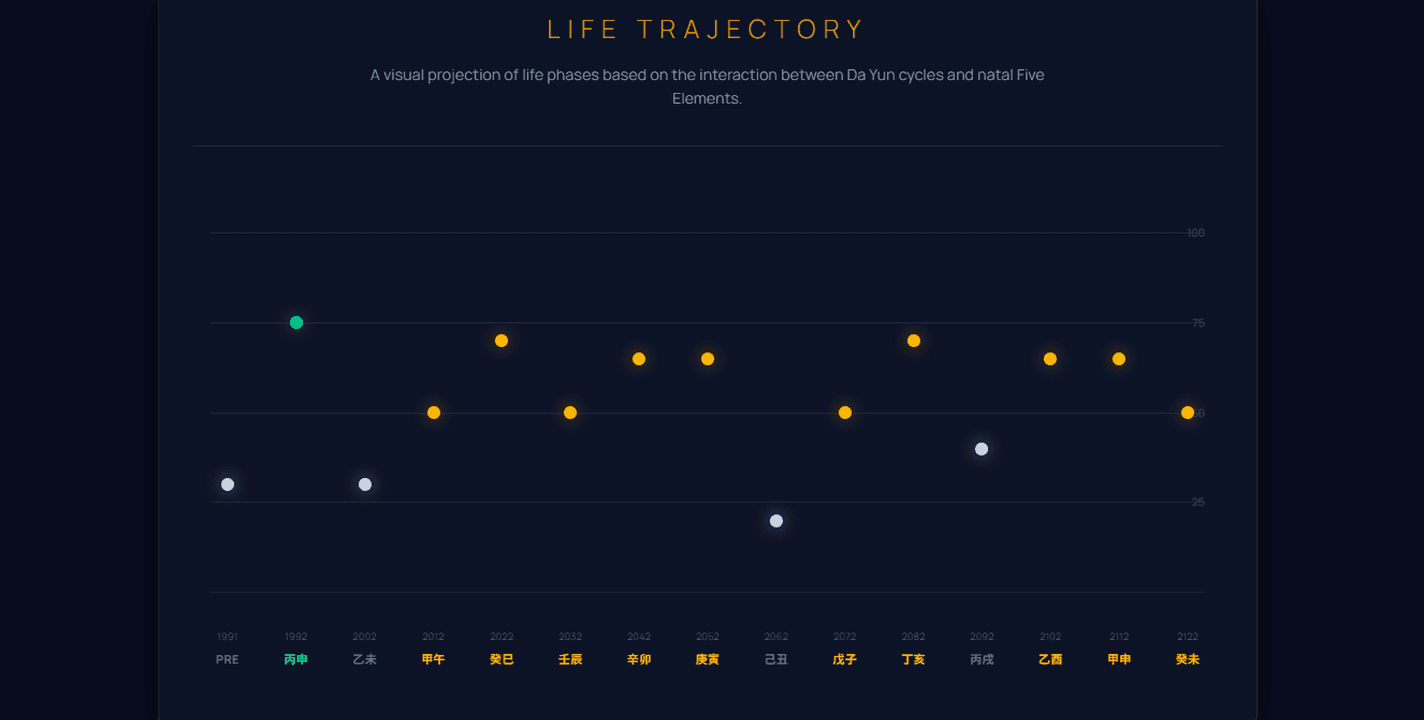
Beyond the static birth chart, Bazi uses two dynamic time cycles to map how fortune evolves throughout life.

Major Luck Cycle (Da Yun)

The Luck Pillars divide life into ten-year phases, each governed by a unique stem-branch pair derived from the Month Pillar. The direction of progression depends on the gender and the Yin/Yang polarity of the birth year: Yang year males and Yin year females count forward through the sexagenary cycle; the reverse counts backward.

The onset age of the first Luck Pillar is calculated by counting the number of days from the birth date to the next (or previous) seasonal node, then dividing by three. Each day equaling four months of life. This methodology is documented in the Yuanhai Ziping.

Annual Fortune (Liu Nian)

Each calendar year carries its own stem-branch pair from the sexagenary cycle. When this Annual Pillar interacts with the natal chart and the current Luck Pillar, forming harmonies, clashes, or combinations, it activates or suppresses specific elements and Ten God relationships, producing the year's fortune pattern.

MONTH DETERMINATION: SOLAR TERMS

A critical distinction in Bazi: the month pillar is determined by Solar Terms, not by the first day of the lunar month. Each month begins at a specific seasonal node. For example, the first month (Yin / Tiger) starts at Li Chun (Start of Spring), typically February 3 to 5. This means two people born in the same lunar month may have different month pillars if a solar term falls between their birthdays.

Source: Wikipedia — Four Pillars of Destiny, §Structure; Chinese calendar §Solar terms

CLASSICAL TEXTS

The foundational canon of Four Pillars methodology, accumulated over a millennium of practice:

Yuanhai Ziping《渊海子平》Song / Ming Dynasty
The foundational canon of the Four Pillars method, attributed to Xu Ziping. Establishes the Day Master framework and systematizes stem-branch interactions.
San Ming Tong Hui《三命通会》Ming Dynasty (Wan Minying)
The most comprehensive Bazi encyclopedia, cataloguing all 60 Jiazi day pillars with detailed personality and fate analyses for each.
Di Tian Sui《滴天髓》Song Dynasty (attributed)
A compact philosophical treatise on Bazi. Known for its cryptic verses, heavily annotated by Qing-era scholars like Ren Tieqiao.
Qiongtong Baojian《穷通宝鉴》Ming / Qing Dynasty
A major reference on seasonal adjustment (Tiao Hou Yong Shen) — selecting the Useful God based on the month of birth and seasonal balance.

Source: Wikipedia — Four Pillars of Destiny §History & §Structure; Earthly Branches §Hidden stems; San Ming Tong Hui; Yuanhai Ziping §Da Yun; Di Tian Sui
FREQUENTLY ASKED QUESTIONS

What really is Bazi?+
Bazi is a Chinese cosmological system that places an individual's birth moment into the stem-branch calendar. The four pairs of Heavenly Stems and Earthly Branches form a symbolic timing framework for reading personality, cycles, and life themes.
Why are there multiple elements inside an Earthly Branch?+
Earthly branches form the foundation of a Bazi chart. Unlike the pure Heavenly Stems, branches contain "Hidden Stems" — representing complex psychological layers, hidden talents, or suppressed emotions lying beneath the surface.
What are Hidden Stems and why do they matter?+
Hidden Stems are the one to three Heavenly Stems concealed within each Earthly Branch. For example, the Tiger (Yin) branch contains Jia Wood (primary), Bing Fire (secondary), and Wu Earth (residual). They help readers evaluate elemental strength with more nuance than surface-level branch attributes alone.
What is the difference between Da Yun and Liu Nian?+
Da Yun (Luck Pillars) are ten-year macro cycles derived from the Month Pillar that describe the broader background. Liu Nian (Annual Fortune) is the yearly stem-branch that interacts with both the natal chart and the current Luck Pillar. Da Yun frames the stage; Liu Nian helps interpret more specific yearly themes.
Why does Bazi use solar terms instead of lunar months?+
Bazi divides months by Solar Terms (Jie Qi), not by the lunar calendar's first day. For example, the first month (Yin / Tiger) begins at Li Chun (Start of Spring), typically February 3-5. This is because Bazi tracks the Earth-Sun positional relationship (ecliptic longitude), not the Moon's cycle.
Does the Bazi Year Pillar start at Li Chun or Chinese New Year?+
Many Four Pillars systems switch the Year Pillar at Li Chun, Start of Spring, while public zodiac and festival calendars usually follow Chinese New Year. People born between those boundaries may have a public zodiac label that differs from the Bazi Year Pillar, so the charting rule should be stated clearly.
Is Bazi completely predetermined?+
No. Bazi is best treated as a traditional symbolic framework for reading tendencies, cycles, and relationships between chart factors. It can support reflection, but it should not replace practical judgment, professional advice, or personal agency.

ABOUT THE AUTHOR

CT

CosmicTao Research Team

Our content is developed by researchers trained in classical Chinese metaphysics, drawing from primary sources including the Yuan Hai Zi Ping (渊海子平), Di Tian Sui (滴天髓), and Zi Ping Zhen Quan (子平真诠). All articles are reviewed for accuracy against established scholarly interpretations.

This article is for educational purposes. Chinese metaphysics is a cultural and philosophical tradition, not a substitute for professional advice.